Service hotline:
400-8858-119
Sales hotline:
400-8600-508
Company email:26442***@qq.com
Personal email:26442***@qq.com
Welcome to the official website of Jiangxi Longzheng technology development co., LTD !

Service hotline:
400-8858-119
Sales hotline:
400-8600-508
Company email:26442***@qq.com
Personal email:26442***@qq.com

Longzheng technology development co., LTD──professional fireproof coating manufacturers
Address: no. 2 xiyu road, industrial park, ganzhou economic development zone, jiangxi province
Free hotline:400-8858-119
Cellphone number:15979766999 (Ms Rong)
Telephone:0797-8374201、5556808、5556806
Fax number:0797-5556802
Email:jxlz2008@163.com
Website:http://www.jxlongzheng.com
The intumescent fire-resistant coating, first applied to timber structures by its manufacturer, Youlinsheng, poses several challenges due to its poor weather resistance, susceptibility to aging and peeling, and reliability issues in humid and corrosive environments. During high-temperature flame baking and blistering processes, the resin decomposes, producing dense smoke and toxic gases. Special measures should be taken for tunnels and underground spaces. Intumescent fire-resistant coatings should not be used on the exterior of buildings where people frequently reside. Industries such as nuclear power, electricity, petrochemicals, and chemicals should primarily rely on thick fire-resistant coatings.
Carefully select thin-coating fire-resistant paints, and strictly control the selection of ultra-thin fire-resistant paints
In order to strictly control all construction activities, the civilian application of fire-resistant coatings, especially for steel columns, steel beams, steel floors, and steel evacuation stairs in large public buildings, must be strictly regulated. For major building components such as steel columns, steel floors, and evacuation stairs, fire-resistant materials like steel mesh concrete should be preferred. Choosing thick fire-resistant coatings can indeed be challenging, and thin fire-resistant coatings should be used with caution. The selection of ultra-thin fire-resistant coatings must be strictly controlled. For high-rise and multi-story buildings, thin coatings and ultra-thin fire-resistant coatings are not suitable.
Select fire-resistant coatings based on the building's location and fire safety requirements
Coatings in buildings that do not require high appearance quality. Fire-resistant coatings should preferably be applied using thick steel plate structures, as recommended by Youlinsheng Fire-resistant Coating Manufacturer. For bare steel trusses, steel roof trusses, and roof load-bearing structures, when the fire resistance limit specified by the regulations is less than 1.5 hours, thin coatings or ultra-thin fire-resistant coatings can be used. When the fire resistance limit exceeds 2 hours, thick fire-resistant coatings should be selected.
Fire-resistant coating is a type of special coating with a wide variety in China. This coating is primarily used in engineering to prevent the spread of flames, protect load-bearing components, and reduce fire damage. It is an important material for building fire protection. It serves two main functions: when applied to combustible substrates, it not only provides the same decorative, anti-corrosive, and long-lasting protective properties as ordinary decorative coatings, but also acts in the same way as steel structures when exposed to flames or heat radiation. Furthermore, fire-retardant coatings undergo rapid physicochemical changes, providing thermal insulation and preventing the spread of flames, thus exhibiting flame-retardant properties. When applied to component surfaces, it not only prevents rust, acid, alkali, and smoke but also provides thermal insulation, reducing the surface temperature of the component.
(1) The flame-retardant coating is flame-retardant or non-flammable, so the protected combustible substrate does not come into direct contact with the air, thereby delaying the combustion of the substrate.
(2) When heated by fire, the flame-retardant coating can decompose into non-flammable inert gases, which can dilute the flammable gases decomposed by the heat of the protected substrate and oxygen in the air, thus inhibiting combustion.
(3) Combustion is believed to be a chain reaction caused by free radicals. Flame-retardant coatings containing chlorine and phosphorus decompose into active radicals upon heating, which combine with organic free radicals to interrupt the chain reaction and reduce the burning rate.
(4) The intumescent flame-retardant coating expands and foams under fire, forming a foam insulation layer that seals the protected substrate and prevents it from burning.
For protection lasting more than 2 hours, thin intumescent fire-resistant coatings should be used, as the fire resistance of the coating is not long-lasting. This is determined by its raw materials and fire-resistant principle. These coatings contain more organic components. The coating undergoes physical and chemical changes at high temperatures and acts as an insulator after forming a carbon foam. The intumescent foam has limited strength and is prone to cracking and detachment. A fire resistance limit of more than 21 is necessary. Thick fire-resistant and heat-insulating coatings must be selected.
Indoor fire-resistant coatings should not employ enhanced or effective waterproofing measures. They are directly applied for outdoor spraying and protection. For outdoor use, they should possess characteristics such as waterproofing, frost resistance, aging resistance, corrosion resistance, and resistance to chemical corrosion like acids, alkalis, and salts.
Outdoor fire-resistant coatings are generally not chosen for indoor fire protection. To ensure the excellent performance of outdoor fire-resistant coatings, strict requirements are imposed on their raw materials. Some special materials need to be applied, so their prices are much higher than those of indoor fire-resistant coatings. However, for semi-open or certain wet-type applications, outdoor fire-resistant coatings should be chosen for protection.
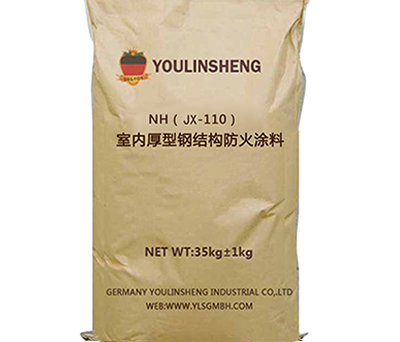
Thick-coating fire-resistant paint is primarily composed of inorganic materials. The coating is stable and ages slowly. As long as the coating does not peel off, its fire resistance is guaranteed. Considering durability and fire resistance, thick-coating fire-resistant paint should be chosen. Jiangxi Youlinsheng Fire-resistant Paint Manufacturer
 Online Service


